smart friction
How we used content and a simple interface to reduce scam attacks.
00
problem
In 2022, Bitso faced a rapidly escalating fraud problem. Crypto scammers were targeting users—particularly in Brazil—and persuading them to withdraw funds under false pretenses. Within a single year, the impact became impossible to ignore: 7,500 victims $2.8 million in user losses 86% of victims located in Brazil Fraudsters were operating across multiple channels, including social media and messaging apps, often staying on calls with victims while guiding them step-by-step through withdrawals. As a Product Designer, I was tasked with redesigning the platform’s scam warning experience. The goal was to actively interrupt fraudulent transactions without introducing excessive friction for legitimate users.
solution
The problem was not a lack of warnings, but instead, it was how users experienced those warnings while under psychological pressure. Fraud prevention required a different design principle: Clever fraudsters + overwhelmed users = the need for Smart Friction Instead of minimizing friction, we needed to introduce the right amount of friction to disrupt the scammer’s control over the user. The objective was to slow users down just enough to break the scammer’s influence while keeping the withdrawal process functional for legitimate users.
The Problem
The existing scam warning flow relied primarily on checkbox confirmations before a crypto withdrawal.
What Worked
Users were explicitly warned about scams.
A “Report a scam” call-to-action allowed users to contact support.
What Failed
However, real-world usage revealed critical flaws:
Scammers coached victims in real time, telling them exactly which boxes to check.
The Report a scam button redirected to a complicated form, leading many users to abandon it.
Victims often proceeded with withdrawals despite seeing warnings.
The system assumed users were acting independently. In reality, many were under active manipulation.

Discovery & Research
To understand the problem more deeply, we mapped both scammer and victim journeys.
Key Behavioral Pattern
Victims often realized they were being scammed only after multiple withdrawals.
In Brazil, many users detected the fraud after approximately four withdrawals, by which point the funds were unrecoverable.
Another critical behavioral segment had already been identified by the Brazilian Securities and Exchange Commission:
“Pagaram para ver” — “Paid to see.”
These users suspected something was wrong but still sent money due to the urgency imposed by scammers.
The typical psychological conditions included:
Artificial time pressure
Emotional manipulation
The promise of unrealistic investment returns
Continuous coaching by the scammer
Under these conditions, users often missed warnings entirely or ignored them.
The Strategy: From Checkboxes to Storytelling
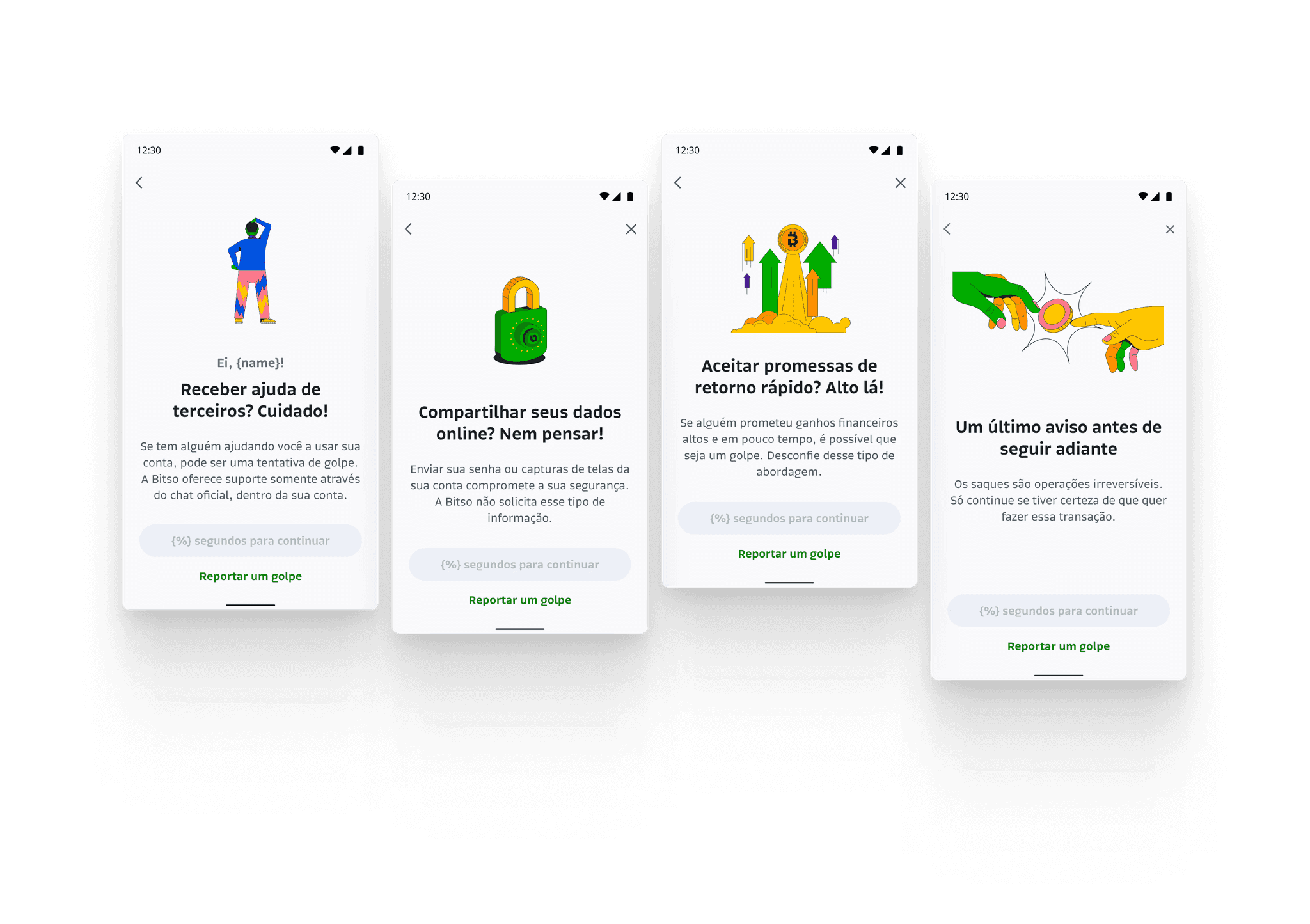
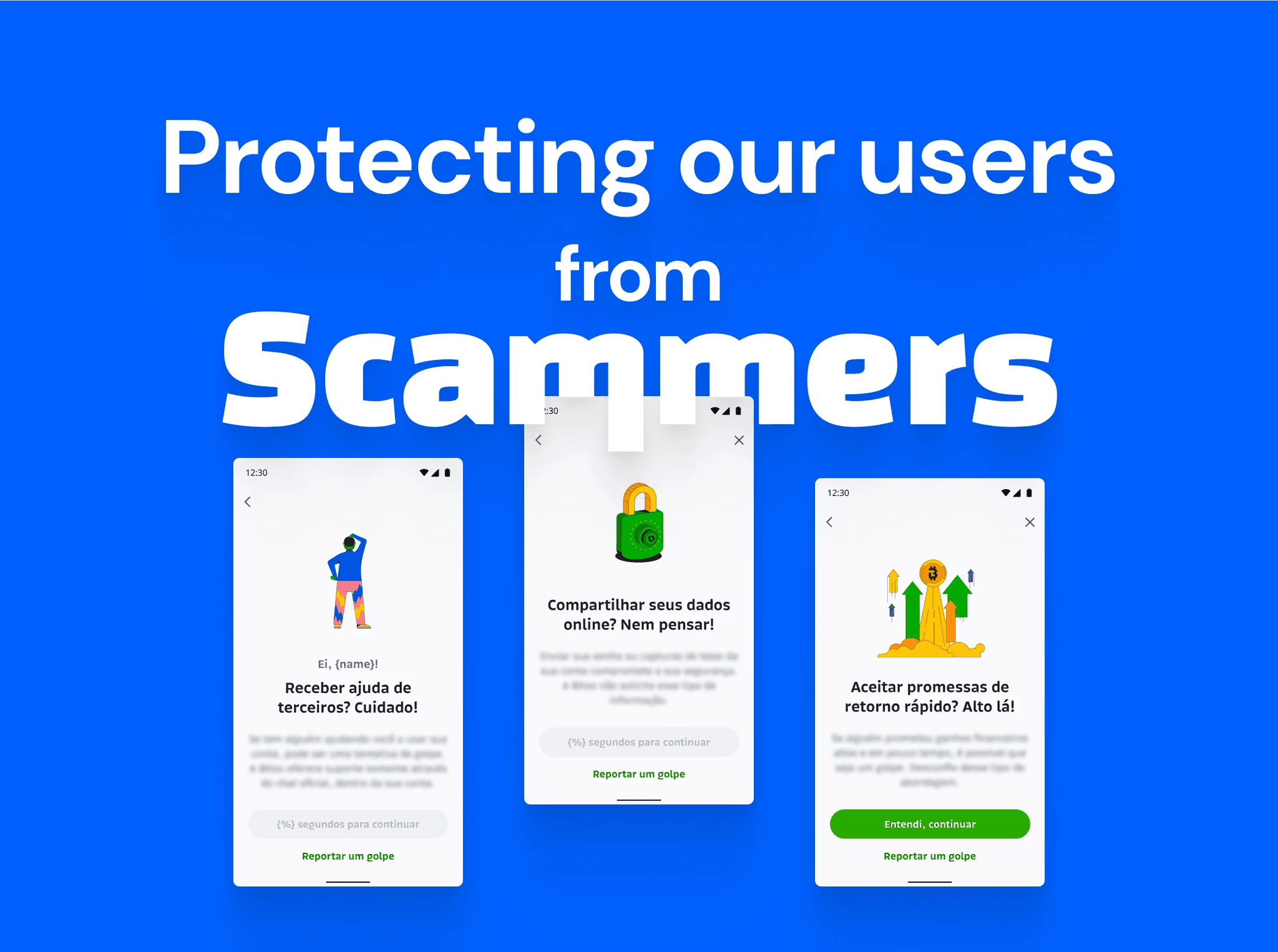
The redesign replaced static checkboxes with a four-screen conversational flow designed to interrupt the scam dynamic.
Three design principles guided the new experience.
1. Emotional Connection
Illustrations developed with the Creative Lab helped reduce cognitive load and made warnings feel more human rather than bureaucratic.
2. Personalization
The first screen addressed the user by name, interrupting autopilot behavior and creating a moment of personal reflection.
3. Direct Action
Instead of redirecting users to a complex form, we introduced a chat-based support option, making it immediately easy to report suspicious activity.
The Design: Addressing the Scammer’s Lies
Each screen was designed to counter a specific narrative commonly used by fraudsters.
Screen 1 — Third-Party “Help”
Users were warned that platform support is provided only through official channels, never through social media or private messaging.
Screen 2 — Personal Data
Clear reminders discouraged users from sharing passwords, authentication codes, or account information.
Screen 3 — Unrealistic Returns
This screen addressed the classic scam promise: guaranteed high returns.
Screen 4 — Irreversibility
The final screen emphasized a critical truth of cryptocurrency:
Once a withdrawal is sent, it cannot be reversed.
This point proved particularly effective in prompting users to reconsider the transaction.
Results
The redesigned experience was rolled out to 7,202 Brazilian users making their first crypto withdrawal.
Initial Impact
10% reduction in scam-related withdrawals
Scam report rate decreased from 8% to 6%
These early signals suggested that the friction was preventing scams before they fully unfolded.
Post-Iteration Improvements
After introducing the chat-based support CTA, results improved significantly among first-time withdrawal users.
Scam report rate dropped from 13% to 1%
Withdrawal completion among users who reported scams fell from 98% to 25%
This showed that the system successfully stopped high-risk transactions at the moment of decision.
Overall Platform Impact
The intervention produced different effects depending on the user segment:
High-risk users: Strong reduction in scam-related withdrawals
Regular users: Moderate impact on withdrawal completion
Completion rates for non-scam users decreased only 6.4 percentage points (95% → 88%), an acceptable trade-off given the security benefits.
Qualitative Validation
User feedback confirmed the behavioral impact of the redesigned flow.
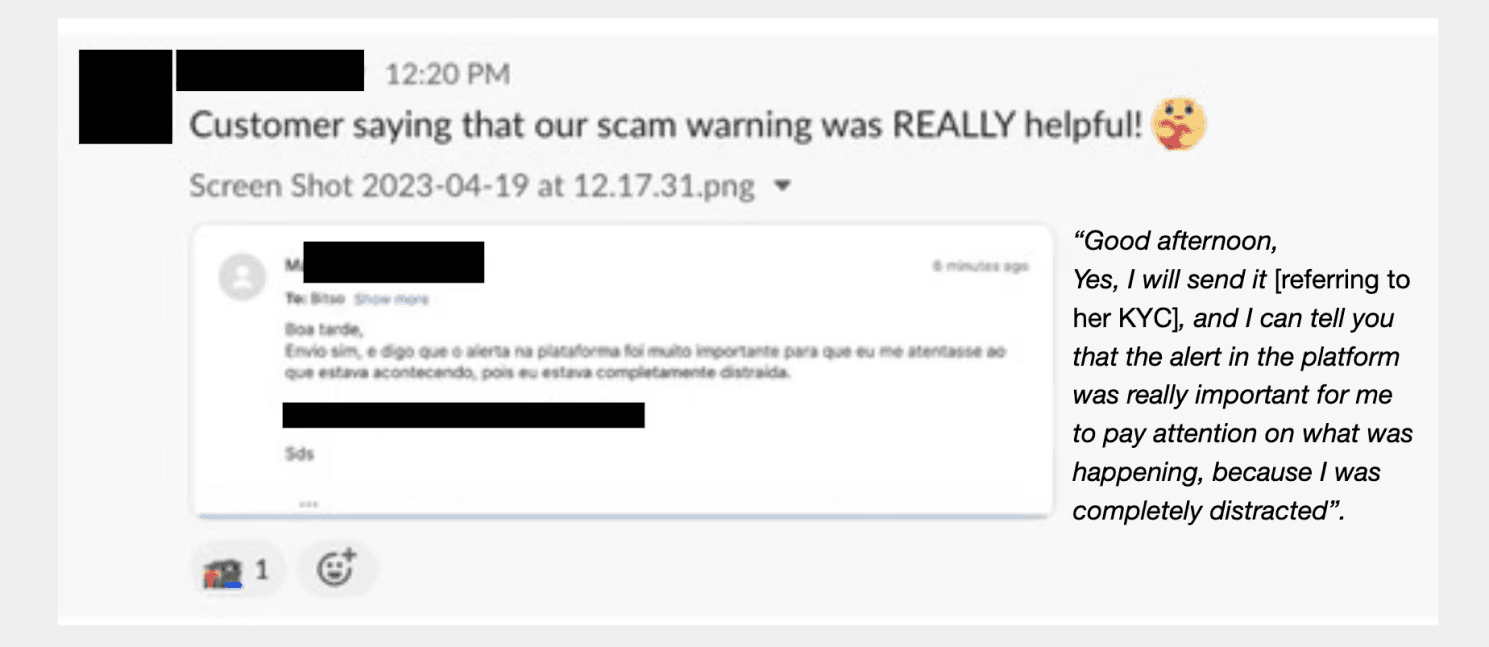
“The alert in the platform was really important for me to pay attention to what was happening, because I was completely distracted.”
Support teams also reported that customers:
Became more aware of suspicious behavior
Recognized scams earlier
Felt reassured by the platform’s intervention
Outcome
The Smart Friction redesign achieved multiple goals simultaneously:
Reduced scam-related withdrawal activity
Prevented high-risk transactions
Lowered scam report rates
Maintained acceptable withdrawal completion rates
Increased user awareness of fraud risks
year
2023
tools
Figma
category
Product Design
01